
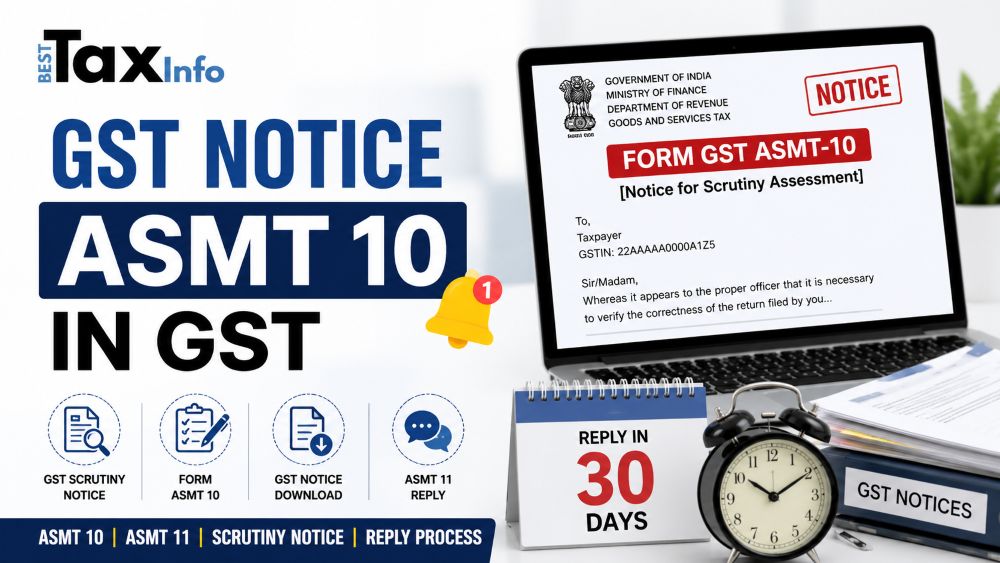
GST Notice ASMT 10 in GST is far more common than most business owners realize, and it does not automatically mean you are facing a penalty or legal trouble.
The ASMT 10 is a formal scrutiny notice issued by GST authorities when they detect discrepancies in a taxpayer’s filed returns. Rather than jumping straight to penalties, the department gives you a structured opportunity to explain, justify, or correct those inconsistencies. However, ignoring this gst notice or responding carelessly can quickly escalate into audits, demand orders, and serious financial liability.
This comprehensive guide explains everything you need to know about ASMT 10 in GST — what it means, why you received it, how to file a proper reply via ASMT 11, and what to expect afterward. Whether you are a business owner, accountant, or GST practitioner, this article will equip you with the knowledge to handle a gst scrutiny notice confidently and correctly.
Table of Contents
What is GST Notice ASMT 10 in GST?
Form GST ASMT 10 is a scrutiny notice issued by the proper GST officer to a registered taxpayer when inconsistencies or mismatches are found between the taxpayer’s filed returns and the data available with the GST department. Simply put, it is an official communication alerting you that something in your returns does not add up — and asking you to explain why.
Crucially, gst asmt 10 is not a demand notice and it is not a show-cause notice. It is a preliminary, conversational step in the compliance process — a chance for the taxpayer to clarify before the department takes any further action. Most notices that are responded to properly and promptly close without any penalty or demand.
The notice specifies:
- The tax period under scrutiny
- The nature of the discrepancy observed
- The quantified amount of suspected short payment or excess credit (wherever calculable)
- A deadline — typically 30 days — to submit your explanation
Legal Basis of ASMT 10 Under Section 61 of CGST Act
The GST Notice ASMT 10 in GST derives its authority from two pillars of GST law:
- Section 61 of the Central Goods and Services Tax (CGST) Act, 2017 empowers the proper officer to scrutinize returns filed by a registered person, verify their correctness, and inform the taxpayer about any discrepancies found.
- Rule 99 of the CGST Rules, 2017 lays out the precise procedural framework. Under Rule 99(1), when discrepancies are identified in a return compared to available data, the proper officer is required to issue Form GST ASMT 10 specifying those discrepancies and seeking the taxpayer’s explanation within 30 days (or an extended period as permitted).
Importantly, Indian courts have reinforced the significance of this notice. For instance, the Madras High Court has held that failure to issue ASMT 10 before initiating adjudication proceedings under Section 73 can vitiate the entire subsequent process — meaning this notice is not merely a formality but a legally protected right of the taxpayer.
Common Reasons Why ASMT 10 is Issued
The GST department increasingly uses data analytics tools to compare return data across multiple dimensions. Therefore, several scenarios can trigger a gst scrutiny notice in the form of ASMT 10. The most common reasons include:
1. Mismatch Between GSTR-1 and GSTR-3B
This is the most frequent trigger. When the outward supplies declared in your GSTR-1 do not match the tax liability reported in your GSTR-3B, the system flags it. Timing differences, late amendments, or clerical errors are common culprits.
2. Excess ITC Claimed Over GSTR-2B
The department closely monitors Input Tax Credit (ITC). If the ITC you claimed in GSTR-3B exceeds what is auto-populated in your GSTR-2B — perhaps because a supplier failed to file returns or filed them late — an ASMT 10 may follow.
3. Discrepancies Between GSTR-3B and E-Way Bill Data
If your declared turnover in returns appears significantly lower than what the E-Way Bill data suggests, the officer will seek an explanation through form gst asmt 10.
4. Sudden and Unexplained Fluctuations in Turnover or Tax Liability
A sharp and unexplained spike or drop in turnover compared to previous periods raises analytical red flags. The officer may issue an ASMT 10 to understand whether the variation is genuine or a result of under-reporting.
5. Incorrect HSN/SAC Codes or GST Rate Application
Errors in classifying goods or services — whether applying a lower tax rate, choosing a wrong HSN code, or misclassifying interstate vs intrastate supply — can lead to underpayment of tax and a consequent scrutiny notice.
6. Ineligible ITC Claimed
Claiming ITC on expenses that are blocked under Section 17(5) of the CGST Act (such as personal expenses, motor vehicles for non-business use, etc.) is another common reason for receiving a gst notice.
Key Differences: ASMT 10 vs ASMT 11 vs ASMT 12
Understanding the entire scrutiny workflow makes responding much easier. The process involves three interconnected forms:
| Form | Who Issues/Files | Purpose | Time Limit |
| ASMT 10 | GST Officer issues | Notifies taxpayer of discrepancies; seeks explanation | Taxpayer has 30 days to reply |
| ASMT 11 | Taxpayer files | Reply to ASMT 10 — accept discrepancy or contest it with evidence | Must be filed within 30 days of ASMT 10 |
| ASMT 12 | GST Officer issues | Closure order if the reply is accepted; proceedings end | Officer should act within 30 days of receiving ASMT 11 |
If the officer does not accept the reply in ASMT 11, the matter escalates beyond ASMT 12 — potentially toward a demand notice under Section 73 or 74, or referral for audit under Section 65/66.
Step-by-Step Process to Replying to ASMT 10
Responding to ASMT 10 in GST requires a systematic approach. Here is a proven, step-by-step process to build a strong reply:
Step 1: Read the Notice Carefully and Note the Deadline
Begin by thoroughly reading the form gst asmt 10. Identify the exact tax periods mentioned, the specific discrepancies flagged, and the amounts quantified by the officer. Most critically, note the response deadline — the 30-day clock begins from the date of service of the notice, not the date you first open it.
Step 2: Reconcile Your Returns Internally
This is the most important preparatory step. Pull out and cross-check:
- GSTR-1 vs GSTR-3B for outward supply mismatches
- GSTR-3B vs GSTR-2B for ITC discrepancies
- E-Way Bill data vs declared turnover
- Annual returns versus periodic returns
Prepare a detailed reconciliation statement that clearly explains every difference — whether the cause is a timing gap, a late supplier filing, an amendment, or an error.
Step 3: Choose Your Response Strategy
You have two routes when responding to a gst scrutiny notice:
Option A — Accept the Discrepancy: If the discrepancy is genuine, pay the differential tax and applicable interest using Form DRC-03. Mention the payment details in your ASMT 11 reply. This approach demonstrates good faith and typically results in a quick closure.
Option B — Contest the Discrepancy: If you have a legitimate explanation, prepare a point-by-point rebuttal supported by documentary evidence such as reconciliation statements, supplier invoices, ledger printouts, and portal screenshots.
Step 4: File Your Reply in Form ASMT 11
- Log in to the GST portal (gstin.gov.in)
- Navigate to Services > User Services > View Additional Notices/Orders
- Locate your ASMT 10 notice and click Reply
- Enter your explanation for each discrepancy
- Attach supporting documents (reconciliation statements, invoices, DRC-03 payment proof)
- Submit within the prescribed 30-day window
If you need more time, you may request an extension within the ASMT 11 form itself — no separate form is required for an extension request.
Step 5: Preserve All Acknowledgments
After submitting, download and save the ARN (Acknowledgment Reference Number) generated by the portal. This ARN is your proof of timely compliance and will be essential if any further proceedings are initiated.
What Happens After You File Your Reply?
Once you submit your ASMT 11, the proper officer evaluates your explanation. The outcome takes one of the following paths:
Scenario 1 — Reply Accepted (Most Common Outcome): The officer issues Form ASMT 12, which is a formal closure order. This conclusively ends the scrutiny proceedings for that tax period and those specific discrepancies. No further action is taken.
Scenario 2 — Reply Not Satisfactory: The officer may escalate the matter by:
- Issuing a Show Cause Notice (SCN) / DRC-01 under Section 73 (non-fraud cases) or Section 74 (fraud/suppression cases) for demand determination
- Referring the case for a departmental audit under Section 65
- Ordering a special audit under Section 66
- Initiating inspection or search proceedings under Section 67
Scenario 3 — No Reply Filed: Silence is the worst option. If no ASMT 11 is filed, the officer treats it as “nothing to contest” and may directly proceed to assessment, demand, or audit.
Critical Mistakes to Avoid When Responding
Many taxpayers unknowingly make errors that turn a routine scrutiny into a prolonged legal matter. Therefore, avoid the following:
- Ignoring the notice entirely — There is no such thing as a notice that goes away on its own in GST.
- Missing the 30-day deadline — A missed deadline removes your opportunity to contest gracefully and invites further proceedings.
- Providing vague or generic responses — Answers like “the discrepancy is due to reconciliation differences” without supporting data carry little weight.
- Uploading incomplete documents — Missing invoices, absent reconciliation sheets, or unsigned statements weaken your case significantly.
- Admitting liability prematurely — Never accept a discrepancy in writing without first verifying every figure independently.
- Conflating different tax periods — Ensure your reconciliation and documents specifically address the tax period mentioned in the notice.
How to Download Form GST ASMT 10 from the Portal
The gst notice download process for ASMT 10 is straightforward:
- Log in to https://www.gst.gov.in
- Go to Services → User Services → View Additional Notices and Orders
- Filter by notice type (ASMT 10) and the relevant financial year
- Click on the notice reference number to view the full notice
- Use the Download or Print option to save a copy for your records
Keeping a downloaded and printed copy of every notice is good practice for documentation and future reference during audits or legal proceedings.
Don’t let a gst notice spiral into a demand order. Act now.
Contact BestTaxInfo today for a personalized consultation, expert review of your ASMT 10 notice, and a professionally drafted ASMT 11 reply that protects your interests. Our experts help businesses across India resolve GST scrutiny notices quickly, accurately, and with full compliance.