
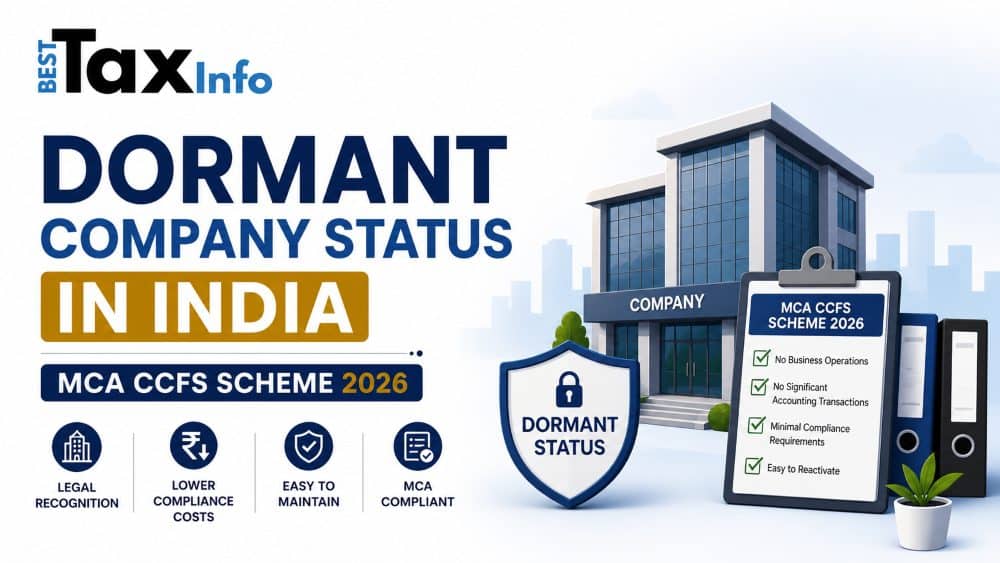
Imagine registering a company with big ambitions — and then watching those plans shift. The company still exists on paper, it has a CIN, active directors, and a registered office, but no real business activity has taken place. Meanwhile, the Ministry of Corporate Affairs (MCA) continues to expect annual returns, financial filings, and compliance forms — year after year, with mounting late fees.
This is a situation thousands of Indian business owners face today. And most of them don’t realize there is a smarter, legally recognized solution called dormant company status in India.
Table of Contents
What Is Dormant Company Status in India?
Dormant company status in India is a formal legal classification that allows a company to remain registered with the Ministry of Corporate Affairs without conducting any active business operations. Rather than forcing inactive companies to either maintain full compliance burdens or apply for strike-off, the law creates a middle path — a legally recognized “pause” mode.
This concept acknowledges a business reality: companies are often registered for future projects, asset holding, intellectual property protection, or as special purpose vehicles — long before any actual commercial activity begins. Instead of penalizing such companies with full compliance requirements, dormant status offers a simplified and cost-effective alternative.
The company dormant meaning in plain terms is this: a company that is alive on paper, legally protected, but officially not conducting any significant business transactions — and registered with the ROC to say so.
Definition of a Dormant Company Under the Companies Act 2013
The definition of a dormant company finds its legal home in Section 455 of the Companies Act 2013, read alongside the Companies (Miscellaneous) Rules, 2014. According to this provision, a company may apply to the Registrar of Companies (ROC) to be classified as dormant if it falls into one of the following categories:
- A company formed for a future project
- A company established to hold assets or intellectual property
- A company that is not carrying on any significant accounting transaction
- A company that qualifies as an “inactive company”
What Is an Inactive Company?
Under Section 455, a company is considered “inactive” if it satisfies any one of the following conditions:
- Has not carried on any business or operations in the last two financial years
- Has not made any significant accounting transaction during the last two financial years
- Has not filed financial statements or annual returns for the last two financial years
Therefore, dormant company as per Companies Act 2013 is a concept that specifically recognizes these inactive entities and offers them a legal framework to regularize their status without winding up.
What Counts as a “Significant Accounting Transaction”?
Not every payment disqualifies a company from dormant status. The Companies (Miscellaneous) Rules, 2014 clarify that the following routine payments do not count as significant accounting transactions:
| Transaction Type | Dormant-Safe? |
| Filing fees paid to the Registrar of Companies | ✅ Yes |
| Payments to maintain the registered office | ✅ Yes |
| Statutory compliance payments | ✅ Yes |
| Share allotment to meet legal requirements | ✅ Yes |
| Maintenance of statutory records | ✅ Yes |
| Commercial sales, purchases, or contracts | ❌ No |
| Loans, borrowings, or investments | ❌ No |
Who Qualifies for Dormant Status?
Dormant company in company law applies to a wide range of situations that are more common than most promoters realize. Here are the most typical use cases where dormant status makes sense:
- Future project companies — incorporated well in advance before actual launch
- Special Purpose Vehicles (SPVs) — created for real estate, infrastructure, or structured finance projects awaiting approvals
- IP holding entities — established to hold trademarks, patents, or copyrights
- Foreign investment companies — incorporated by overseas investors awaiting regulatory clearances
- Group restructuring vehicles — entities preserved within corporate groups for future mergers or reorganizations
- Asset holding companies — created to hold property, equipment, or financial assets
A practical dormant company example: A group of entrepreneurs registers a private limited company in January for a SaaS product they plan to launch in 18 months. During this period, the company holds a bank account, has two directors, but has no revenue, no employees, and no invoices. This entity perfectly qualifies for dormant status company classification under Section 455.
Who Cannot Apply for Dormant Status?
Not every company is eligible. The following categories are explicitly excluded from the dormant status framework:
- Listed companies (companies whose shares trade on any stock exchange)
- Companies currently under inspection, investigation, or prosecution by any regulatory authority
- Companies with outstanding public deposits
- Companies with outstanding statutory dues — taxes, duties, or government liabilities
- Companies with unresolved management or ownership disputes
- Companies that have active commercial transactions
- Companies with outstanding loans (unless the lender has given written consent)
Key Benefits of Obtaining Dormant Company Status
Why should a company pursue dormant status rather than simply ignoring its filings? The answer is both strategic and financial. Here are the primary advantages:
1. Dramatically Reduced Compliance Burden
A dormant company enjoys a simplified compliance regime. It is not required to hold as many board meetings, does not need to maintain the same level of financial disclosures, and files fewer forms with the MCA compared to an active company.
2. Preservation of Corporate Identity
The company retains its CIN, name, and legal existence. This means you don’t lose the brand, the registered entity, or the legal framework — you simply press pause.
3. Flexibility for Future Revival
Activating a dormant company later is a straightforward process. When the business is ready to resume, the company can apply to the ROC to restore its active status without the need for fresh incorporation.
4. Legal Clarity and Regulatory Transparency
Dormant status formally distinguishes a legitimate inactive company from potential shell entities. This protects directors from regulatory scrutiny that might otherwise arise from prolonged inactivity without formal status.
5. Cost Efficiency
Maintaining a dormant company is significantly cheaper than maintaining full compliance for an active company year after year.
Dormant Company Requirements – Eligibility Checklist
Before filing the application, the company must meet all of the following dormant company requirements. Think of this as your pre-application compliance audit:
- The company is not conducting any significant business or accounting transactions
- All pending ROC filings (annual returns, financial statements) are up to date
- No default exists in payment of statutory dues, taxes, or government liabilities
- No outstanding public deposits or defaults in their repayment
- The company is not under any inspection, inquiry, or investigation
- No dispute exists regarding management or ownership of the company
- The company’s securities are not listed on any stock exchange
- No outstanding loans — or written consent obtained from the lender
Meeting all of the above conditions is essential for the ROC to approve the dormant status application.
How to Change Company Status to Dormant – Step-by-Step Process
Understanding how to change company status to dormant involves a defined legal procedure. Here is the complete step-by-step guide:
Step 1: Verify Eligibility
Conduct an internal audit to confirm the company meets all dormant company requirements listed above. Address any pending filings or dues before proceeding.
Step 2: Hold a Board Meeting
Pass a board resolution authorizing the company to apply for dormant status and authorizing a director to sign and submit the application.
Step 3: Obtain Shareholder Approval (if applicable)
If the company has a diverse shareholder base, pass a special resolution in a general meeting. If the company has only a few shareholders and all consent is easily obtained, a board resolution may suffice depending on specific circumstances.
Step 4: File Web Form MSC-1 with the ROC
Submit Web Form MSC-1 on the MCA portal along with the required documents and applicable fees. This is the official application form for dormant status under Section 455.
Key Documents Required:
| Document | Description |
| Board resolution | Authorizing the dormant status application |
| Auditor’s certificate | Confirming no significant accounting transactions |
| Statement of affairs | Showing the company’s current financial position |
| Consent of lender | Required if there are any outstanding loans |
| Latest filed financial statements | Confirming compliance status |
Step 5: ROC Review and Approval
After receiving the application, the ROC examines it. If satisfied, the ROC issues a certificate granting dormant status and publishes the company’s name in the list of dormant companies.
How to Get Dormant Status Under MCA Scheme CCFS 2026 – Discounted Fees
The Companies Compliance Facilitation Scheme 2026 (CCFS 2026) is a one-time amnesty initiative introduced by the Ministry of Corporate Affairs to help companies regularize their compliance backlogs at substantially reduced costs.
The scheme runs from April 15, 2026 to July 15, 2026.
How to get dormant status of a company has never been more financially accessible. Under CCFS 2026, the dormant status fee structure looks like this:
| Application Route | Form | Fee Relief |
| Standard application (normal route) | MSC-1 | Full fee applies |
| Application under CCFS 2026 | MSC-1 | 50% of the normal fee |
| Strike-off under CCFS 2026 | STK-2 | 25% of the normal fee |
| Overdue annual filings under CCFS 2026 | Various | Normal fee + 10% additional fee |
Companies that miss this deadline will have to apply for dormant status at full cost after the scheme lapses.
Dormant Company vs. Strike-Off – Which Option Is Right for You?
Many company owners wrestle between applying for dormant status and simply striking off the company. Here is a clear comparison to help you decide:
| Factor | Dormant Company | Strike-Off |
| Company continues to exist? | ✅ Yes | ❌ No |
| Can resume business later? | ✅ Yes, with ROC approval | ❌ No (requires fresh registration) |
| Brand and CIN preserved? | ✅ Yes | ❌ No |
| Ongoing compliance required? | ✅ Minimal (annual MSC-3 filing) | ❌ None |
| Ideal for companies with future plans? | ✅ Yes | ❌ No |
| Ideal for permanently closed companies? | ❌ No | ✅ Yes |
| Fee under CCFS 2026 | 50% discount on MSC-1 | 75% discount on STK-2 |
Therefore, if your company holds a valuable brand name, an intellectual property asset, or represents a project you intend to revive — dormant status is the smarter choice. However, if the company serves no future purpose, strike-off under CCFS 2026 at 75% cost reduction is a financially attractive exit.
Ongoing Compliances for a Dormant Company
Dormant status does not mean zero compliance. While the requirements are significantly reduced compared to an active company, a dormant company still needs to fulfill these ongoing obligations:
Annual Filing – Form MSC-3
Every dormant company must file Form MSC-3 (Return of Dormant Companies) within 30 days from the end of each financial year. This form confirms that the company has remained inactive and has not crossed the threshold into active company territory.
Board Meetings
A dormant company is required to hold a minimum of one board meeting every half year (i.e., at least 2 meetings per calendar year), with a gap of not more than 90 days between meetings.
Maintenance of Statutory Records
Even in dormant mode, the company must maintain its statutory registers and records as required under the Companies Act 2013.
Preservation of Dormant Status
The company must ensure it continues to meet the eligibility conditions for dormancy. Any breach — such as entering into a commercial contract or making an investment — could revoke its dormant status automatically.
Activating a Dormant Company – What Happens Next?
Activating a dormant company is a relatively straightforward process once the company is ready to resume business. The company files an application with the ROC requesting restoration to active status. The ROC, upon verifying that the company has filed all pending MSC-3 returns and is otherwise compliant, grants approval and updates the company’s status from dormant to active.
However, the law also provides that if a dormant company remains dormant for five consecutive years, the ROC has the authority to initiate strike-off proceedings. Therefore, companies should plan their revival timeline well within this five-year window.
Don’t let the July 15, 2026 deadline pass you by. Contact BestTaxInfo today for a personalized consultation and take the smartest legal step for your company’s future.